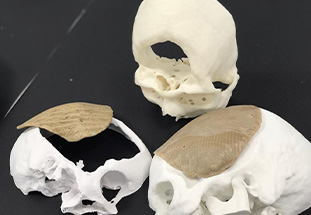
Scaling Precision Medicine Beyond Borders Through 3D-Printed Cranial
Implants
The AKU-dHRC 3D Printing Facility continues to advance personalized surgical
care
by designing and manufacturing high-precision and patient-specific implants
using biocompatible PEEK (Polyetheretherketone) technology. After pioneering
these implants in Pakistan for complex cranioplasty cases, dHRC has extended
this life-changing innovation internationally. In collaboration with Aga
Khan
University Hospital (AKUH) Kenya, two customized cranial implants were
successfully produced and implanted in Nairobi, marking a major milestone in
AKU’s global integration of advanced medical technologies.
Each implant was engineered using patient imaging data to ensure anatomical
accuracy, optimal fit, improved biomechanical strength, and reduced
operative
time; ultimately supporting better surgical outcomes and faster recovery.
This
cross-border clinical collaboration showcased the precision and efficiency
of
dHRC’s design-to-delivery workflow, as well as demonstrated the safety,
regulatory compliance, and clinical readiness of locally manufactured
implants.
The milestone reinforces AKU’s commitment to equitable access to specialized
care and positions the 3D Printing Facility as a growing hub for biomedical
innovation.
Strengthening Medical Education Through Locally Produced Anatomical
Training Models
To enhance high-quality surgical and anatomical training across AKDN
institutions, the AKU-dHRC 3D Printing Facility has taken the lead in
producing
precise and customizable bone models for medical education. Previously
sourced
from commercial vendors at high cost and with limited customization options,
these essential training tools are now being manufactured in-house using
advanced 3D printing technologies.
The transition to local production has established a steady supply of
anatomically accurate bone models tailored specifically to the clinical
objectives of AKU’s medical colleges in Pakistan and Kenya. This reflects
better
alignment with curriculum needs and significantly reduces procurement costs,
while improving accessibility to training materials.
These 3D-printed models have been successfully integrated into Dry Labs for
procedural skill-building, receiving consistently positive feedback from
faculty
and learners alike. By leveraging internal technical capabilities, dHRC has
strengthened institutional self-sufficiency and paved the way for scalable
and
context-driven innovations in medical education across AKU.
Enabling Affordable Cancer Care Innovation: Locally Manufactured Smit Sleeve
To enhance access to high-quality cancer treatment, the AKU-dHRC 3D Printing Facility partnered with the Oncology Department at the AKUH to locally produce Smit Sleeve, a critical intrauterine device used in brachytherapy for cervical cancer. Previously imported at a cost ranging from PKR 30,000–35,000 per patient, these devices were designed for single-use only, adding substantial financial burden for women requiring multiple treatment cycles.
Leveraging biomedical engineering expertise and medical-grade 3D printing, dHRC successfully manufactured a customized Smit Sleeve using materials that can withstand sterilization procedures, allowing safe reuse for the same patient. This advancement reduced the cost by more than one-third and also ensured availability without dependency on international supply chains.
The first clinical application demonstrated excellent performance, with a precise anatomical fit, smooth procedural workflow, and no reported adverse effects. This innovation improves patient care through accessible, affordable, and locally produced medical solutions, particularly for underserved oncology populations.