


The Digital Health Resource Centre (dHRC) organized the “Digital Health Innovations Workshop” in Colombo, Sri Lanka, bringing together government representatives, healthcare professionals, and program managers from across the region. Delegates included members from the Aga Khan Foundation, Kyrgyz Republic, a representative from the Ministry of Health, the Kyrgyz Republic, and Department of Health - Khyber Pakhtunkhwa and Gilgit Baltistan, French Medical Institute for Mothers and Children, and participants from Aga Khan Health Services - Afghanistan, Pakistan, and Tajikistan.
The two-day workshop provided a platform to disseminate findings and share experiences from key digital health programs implemented across AKDN, including the Hayat mHealth initiative, the F4HE digital health program, and the Sehatmandi project. Workshop focused on implementation challenges, lessons learned, programmatic impact, and strategies for scaling and sustaining digital health solutions. Participants also explored opportunities for future initiatives, including digital health grant proposals and country-specific program adaptations.
By facilitating cross-country learning and collaboration, the workshop strengthened knowledge-sharing, promoted evidence-based approaches, and enhanced the capacity of health professionals and program managers to advance digital health initiatives in their respective countries.
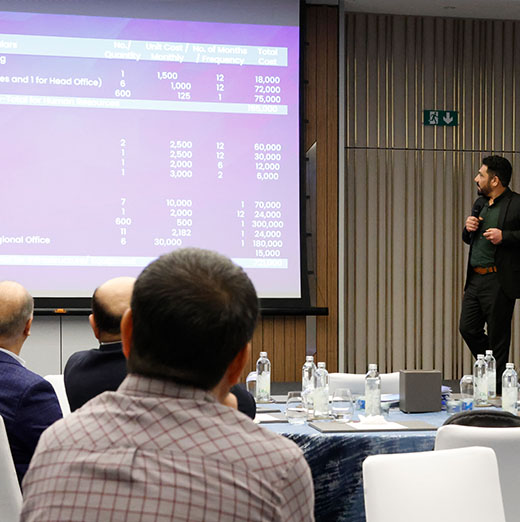
At the F4HE Dissemination Seminar in Pakistan, we presented key research findings and program insights, providing a comprehensive overview of the scope, impact, and contributions of our digital health initiatives. The seminar highlighted both the innovation and practical outcomes achieved under the F4HE program, particularly in strengthening health systems in underserved and hard-to-reach areas.
Key presentations showcased how telemedicine and e-learning programs have successfully expanded access to quality healthcare services and training, while strategic collaboration with government partners was emphasized as crucial for program adoption, scalability, and sustainability. Project indicators demonstrated measurable improvements in service delivery, increased utilization, and tangible positive health outcomes.
Additionally, findings from the Sehatmandi mHealth intervention were shared, detailing enablers, challenges, lessons learned, and strategies for long-term integration into the broader health system. The seminar reinforced F4HE’s commitment to evidence-based programming and highlighted the remarkable potential of digital health solutions in improving access, equity, and quality of care.
Dr. Saleem Sayani represented the institution as a Distinguished speaker at the 2nd International Additive Manufacturing & Vacuum Technology (IAMVT) Conference, held from October 21–23, 2025, at National Centre for Physics, Islamabad. The event was jointly organized by the Pakistan Institute of Additive Manufacturing (PIAM3D) and the National Institute of Vacuum Science & Technology (NINVAST). The conference brought together experts, researchers, and industry professionals to promote the practical adoption of additive manufacturing (AM) and vacuum technologies globally. Key discussions covered advances in AM, including polymer printing, lightweight structures, ceramics, and high-entropy alloys, design for AM, and quality assurance for aerospace and biomedical applications. Participants also explored critical themes in vacuum science, such as precision metrology, leak testing, materials innovation, and applications in space technologies.
Dr. Sayani’s presentation highlighted AKU’s innovation journey in 3D printing, focusing on the development of healthcare applications, from advanced surgical models and prosthetics to training tools for medical professionals. He discussed the evolution of 3D printing technologies at the institution, strategies for overcoming adoption challenges, and the transformative impact of these innovations on healthcare delivery, particularly in low- and middle-income contexts. His session emphasized how practical applications of additive manufacturing can drive both clinical and educational improvements while fostering research and technological growth in LMICs.
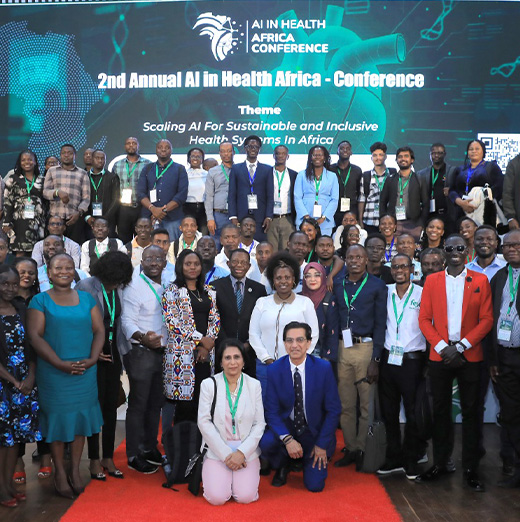
Arham Shaikh, Associate at the AKU-Digital Health Resource Centre (dhRC), represented the organization at the 2nd AI in Healthcare Conference in Africa, an international gathering of researchers, clinicians, innovators, and AI experts. The conference focused on advancing artificial intelligence solutions for healthcare systems in low-resource settings, with particular attention to maternal health, digital diagnostics, and medical imaging.
As part of the event, Arham participated in the NAAMI Blind Ultrasound AI Hackathon, centered on developing AI models to estimate gestational age using low-cost blind ultrasound sweep videos from five countries: Nepal, Pakistan, Kenya, Uganda, and Nigeria. The challenge aimed to address critical barriers in maternal care, particularly the lack of trained sonographers and advanced imaging technology in underserved regions. From a large pool of global applicants, Arham’s team was selected among the Top 10 teams for intensive online training with medical AI experts. Following successful completion of technical assignments in data understanding, model prototyping, and fairness evaluation, the team advanced to the Top 5 finalists, earning the opportunity to attend the conference and participate in the in-person hackathon in Uganda, Africa.
During the competition, the team developed a lightweight AI model focused on accurate, fair, and deployable gestational age prediction, with emphasis on reducing site-based disparities and enabling real-world usability in low-bandwidth environments. Their final prototype included end-to-end training and an inference pipeline aligned with the hackathon’s evaluation framework. These efforts reflect engagement in global digital health innovation and reinforce clinically responsible AI solutions for improving maternal and newborn health outcomes.
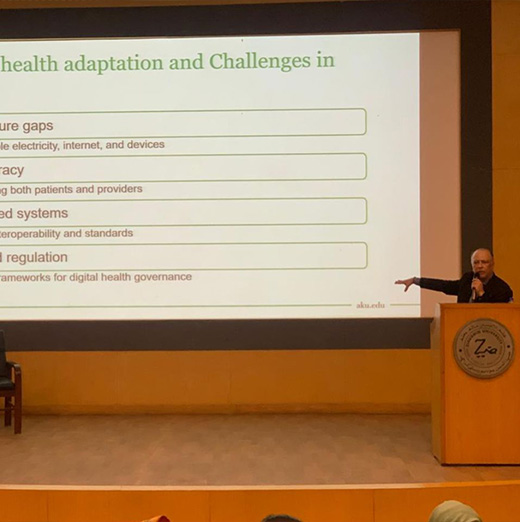
As part of the Public Health program at Ziauddin University, Saleem Sayani - Director dHRC, delivered an engaging guest lecture. Dr. Sayani provided an in-depth overview of the dHRC Digital Health Programme, highlighting telemedicine initiatives, AI-driven interventions, and the integration of 3D printing innovations in healthcare and education. The session offered valuable insights into the challenges and opportunities of adopting digital health solutions in low- and middle-income countries (LMICs), showcasing how global technological advancements can be adapted to create locally impactful, equitable, and sustainable healthcare solutions.